




Plaque Wording:
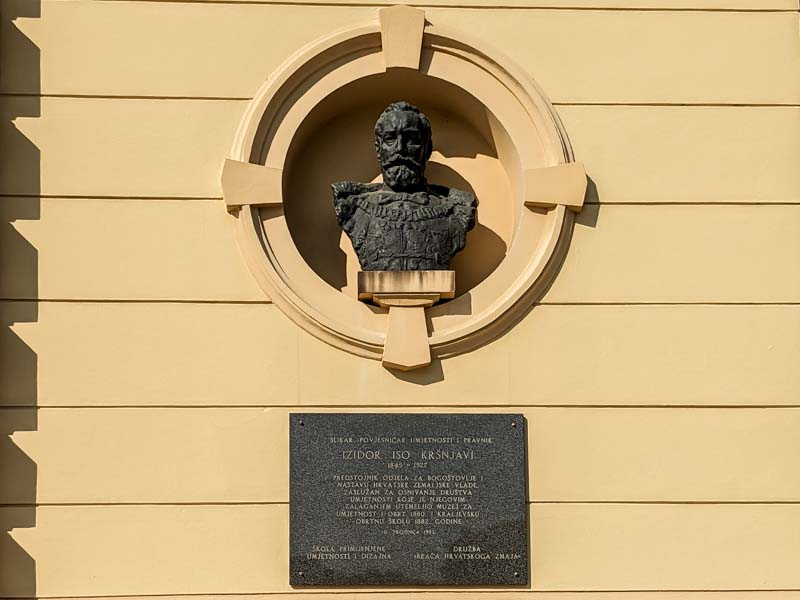
Painter Art Historian Lawyer Izidor Iso Krsnjavi 1845-1927 President of the Department of Religious Education of the Croatian National Government Asluzan for the foundation of the Society: the arts which were established through his advocacy The Museum of Arts and Crafts 1801. Society of Croatian Dragon Brothers


Plaque Wording:
In memory of John Harvard founder of Harvard University in America baptized in this church 29 November 1607








Plaque Wording:
William Morris poet craftsman socialist lived here 1878-1896


Plaque Wording:
Barcelona to the parents and sister of Pablo Picasso, Don José Ruiz Blasco, Doña María Picasso López, Doña M de los Dolores Ruiz Picasso
October 1988


Plaque Wording:
This is the place where 360 members of the Navy Women Battalion had 19 trials in 1992 for the defence of the motherland in front of the commander, Admiral Svete Letice


Plaque Wording:
Wick house a residence between 1772 and 1792 of Sir Joshua Reynolds p.r.a. was purchased, re-built and equipped from funds provided by the joint committee of the Order of St John and the British Red Cross Society as a home for the nurses of the Star and Garter home for disabled sailors soldiers and airmen. The home was opened by Lord Wakehurst K.C.M.G. Vice-chairman of the joint committee on 27th october 1950


Plaque Wording:
Santiago Rusiñol Artist and writer was born in this house on February 25, 1861
Barcelona, 1997


Plaque Wording:
Manor House station
Architect: Adams, Holden & Pearson (Charles Holden) 1932
Opening on 19 September 1932, this was the first station on the northern extension of the Piccadilly line beyond Finsbury Park.
The station has very little prominence at street level with only limited canopy structures over the park-side entrances. There were also originally subways that served now demolished tram loading shelters that stood in the middle of the road. The asymmetrical ticket hall was carefully designed so to make best use of space and Holden took great care in the details and finishes to features such as the central columns. The ceiling, decorated in a pattern of circular mouldings with inset lighting compliments the unusual shape of the ticket hall.
The platforms were lined to give an elliptical or egg shaped profile to enable the recessing of equipment and furniture to give clear lines of sight. The platforms tiles were originally made by Carter's Poole Potter{y} in Dorset and are similar to other adjacent stations apart from the different coloured border tiles - here they are blue. Also of note are the bronze ventilation grilles that depict a stylised play on the station name. These were designed by Harold Stabler R.D.I., a notable artist and designer, who was elected a "Royal Designer for Industry" in 1936 He was closely connected with the Poole Pottery.
In 2006 a modernisation of the station resulted in the platform wall tiles being sensitively replicated according to the original design. In addition the crude strip lighting that had disfigured the ticket hall ceiling was removed.


Plaque Wording:
Turnpike Lane Station
Listed as a building of national significance
Architect: Charles Holden & Partners, 1932
Built as part of the 1932/33 Piccadilly line extension to Cockfosters from Finsbury Park, this station was designed to act as an interchange between trains, bus and tram. One now disused subway entrance used to allow access to a road island that formed a tram stop. The building is typical of the Holden 'brick box' style of station, here with tall, vertical ventilation towers that give a greater street presence. The ticket hall's high ceilings are exaggerated by the fact that the floor is several meters below street level. The fluted bronze uplighters are rare survivors and are typical of Holden's care and attention to design detail.
The platform tiles were originally made by Carter's Poole Potter in Dorset and are similar to other adjacent stations apart from the different coloured border tiles. Noteworthy are the bronze ventilation grilles that depict a stylised play on the station name. These were designed by Harold Stabler R.D.I., a notable artist and designer, who was elected a "Royal Designer for Industry" in 1936. He was closely connected with the Poole Pottery.
In 2006 a modernisation of the station resulted in the platform wall tiles being sensitively replicated to the exact original scheme.


Plaque Wording:
In this house lived and died the painter and citizen of Kraków, Michał Stachowicz Born August 14, 1768, Died March 26, 1825.
A passionate lover of his hometown, who in his paintings preserved for posterity the monuments of Kraków, the great historical events of the era of T. Kościuszko and Prince Józef Poniatowski, as well as the life and customs of the people.
This plaque was funded by the City Administration in 1939.


Plaque Wording:
St Matthew's Westminster Built in 1849 to the designs of Sir Gilbert Scott it was later greatly enriched with fittings and glass by G.F. Bodley, C.E. Kempe, Martin Travers and others. The Lady Chapel is one of Sir Ninian Comper's finest early works. Gutted by fire in 1977 it was reconstructed to a reduced plan and rededicated in 1984.


Plaque Wording:
Birthplace of Emanuel Vidovic 1870-1953


Plaque Wording:
William Taylor Copeland Esq Alderman M.P. Lord Mayor of London 1835-36 The first President of St Mark's Hospital Painted and presented by James Ward Esq R.A. April 1854


Plaque Wording:
South London and Maudsley Trust
Xavier Hilts White was treated here April/June 1985 head injury survivor artist and Bethlem Gallery volunteer
SlaM 2018
Xavier Hilts White was treated here April/June 1985 head injury survivor artist and Bethlem Gallery volunteer
SlaM 2018


Plaque Wording:
[can't read it]


Plaque Wording:
In the years 1883 - 1895 lived and worked here Stanislaw Wyspianski 1869 - 1907 The great Polish poet and painter


.jpg "Sponsor: British Plaque Trust (id: 65)")
_ls.jpg)


Plaque Wording:
The Adelphi This building stands on the site of Adelphi Terrace built by the brothers Adam in 1768 - 1774. Among the occupants of the Terrace were Topham and Lady Diana Beauclerk, David Garrick, Richard Doyly Carte, Thomas Hardy & George Bernard Shaw, The London School of Economics and Political Science and the Savage Club also had their premises here. LCC 1951












.jpg "Sponsor: English Heritage (id: 426)")
_ls.jpg)